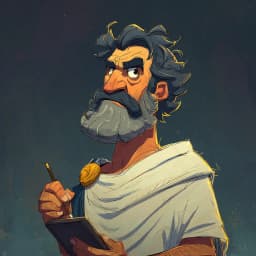
Thucydides
Thoukydides
Son of Olorus — the name suggests Thracian aristocratic descent, the same Thracian family in which the elder Cimon had married a generation earlier — and of Hegesipyle, of the Athenian deme Halimous. Held land and gold-mining rights at Skapte Hyle in Thrace opposite Thasos (the Skapte mines in the Pangaion-Symbolon range, the same ore-system Philip II would reorganise sixty years later as the Philippi treasury). Elected *strategos* for the Aegean-Thrace command in 424 and stationed at Thasos with seven ships; Brasidas surprised Amphipolis at dawn with a forced night-march, the historian arrived at Eion at evening of the same day eight hours late (Thuc. 4.103–106). Athens exiled him for twenty years for the loss (Thuc. 5.26.5: 'I was an exile from my country for twenty years after my command at Amphipolis'); he spent the exile in Thrace at Skapte Hyle and travelling, interviewing Spartan veterans and Thracian and Boeotian witnesses for the *History* he was writing. The eight-book work breaks off mid-sentence in the autumn of 411 — Thucydides did not live to finish it; Xenophon's *Hellenica* takes up the narrative from where it stops. Returned to Athens after 404 (the recall under the post-war amnesty); died c. 400, on the testimony of the Marcellinus *Vita* either in Thrace or in his Athenian deme, probably violent death. Buried in the Cimonian family vault outside the Itonian Gate on the road to the Academy.
Origin
Athenian deme Halimous; son of Olorus and Hegesipyle, on the maternal Thracian-aristocratic side a kinsman of the elder Cimon and of the Argead-related Olorid line.