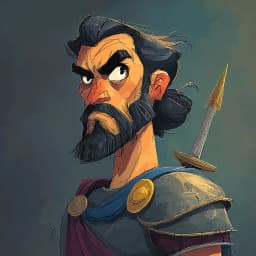
Pausanias of Orestis
Pausanias
One of the seven Royal Bodyguards (somatophylakes) of Philip II, from the highland district of Orestis on the upper Macedonian frontier — a region in the orbit of the Argead court since Philip's recovery of the upper provinces from Bardylis in 358. Diodorus 16.93–94, drawing on Theopompus, gives the proximate motive as a sexual humiliation he had suffered at the hands of Attalus (whose retainers had insulted him) for which Philip had refused him redress when he applied to the king's bench, and which became the private grievance carried for years until the king's wedding-procession at Aegae offered the moment. At the procession into the theatre, with the twelve images of the Olympians preceding Philip and a thirteenth image of the king himself among them, Pausanias closed in from the side with a Celtic dagger and 'pierced him through his ribs, and stretched him dead; then ran for the gates and the horses' (Diod. 16.94.3). 'Caught his boot in a vine and fallen,' he was overtaken by Perdiccas (the future regent) and the rest of the bodyguards 'and killed... with their javelins' (16.94.4). The wider conspiracy — Olympias's hand, possibly Alexander's, possibly Persian gold — has been argued and re-argued from antiquity (Justin 9.7 + Plut. *Alex.* 10.4) onward; the bare bodyguard with the private grievance is the version Aristotle *Politics* 5.1311b prefers. Distinct from Pausanias the Spartan regent, victor of Plataea in 479 BC, entered separately in the catalogue.