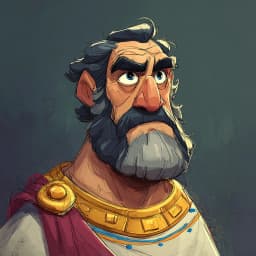
Cocalus
Kokalos
King of the Sicanians whose royal seat was the inland citadel of Camicus, identified by the geographical tradition (Diodorus 4.78.4; Pausanias 7.4.6) with a hill near later Acragas — generally located by archaeologists at Sant'Angelo Muxaro on the river Halycos / modern Platani. He gave shelter to Daedalus when the craftsman fled west from Crete after the wax-wing flight (Apollodorus *Epitome* 1.14; Diodorus 4.78.1–4). Daedalus repaid him in works: the steam-bath at Selinus (Diod. 4.78.2), the underground cistern at Acragas (4.78.3), and the polygonal masonry of the citadel of Camicus itself (4.78.4); at the temple of Aphrodite at Eryx Daedalus dedicated a golden honeycomb so finely worked that it seemed to differ in no way from a natural one (4.78.5). When Minos came west with a fleet hunting his lost architect and tested every host with the puzzle of threading a spiral seashell — knowing only Daedalus could solve it — Cocalus accepted the puzzle, brought it secretly to Daedalus (who threaded it by tying the line to an ant), and so betrayed himself. Cocalus pretended to surrender Daedalus, invited Minos to a guest-bath, and let his daughters scald the king to death with boiling water poured from above (Apollodorus *Epitome* 1.14–15; Diodorus 4.79.1–3). The Cretan crews left without their king and settled in Sicily, founding the coastal town Minoa (later renamed Heracleia Minoa; Hdt. 7.170; Diod. 4.79.5).
Origin
King of the Sicanians of central Sicily (Diodorus 4.78–79; Pausanias 7.4.6).